What an AS 4349.3 timber pest report must include
A timber pest inspection report written to AS 4349.3 has to say what was inspected, what wasn't and why, what timber pest activity, damage and conducive conditions were found, how likely it is that activity was missed, and what the client should do next. It is a record of a visual inspection on one day. It isn't a guarantee, a quote or a structural report.
This page sets out what the report needs to cover, in plain English, with a checklist at the end. It's a summary, not the Standard. AS 4349.3 is copyright and sold by Standards Australia, so check the current Standard for the exact requirements.
Last checked November 2026. Edition in use: AS 4349.3-2010, Inspection of buildings, Part 3: Timber pest inspections.
What is AS 4349.3 for?
AS 4349.3 sets the minimum for how a visual timber pest inspection is done and reported. Government guidance describes it as the benchmark for inspecting and reporting on timber pest activity, and it applies across building classes. Its users include pest technicians, buyers, owners, property managers and building inspectors.
Most pre-purchase pest inspections are written to it. So are many routine termite inspections, although treatment work after a find falls under AS 3660.2, not AS 4349.3.
Which timber pests does it cover?
A standard inspection looks for:
- subterranean termites;
- dampwood termites;
- borers of seasoned timber;
- wood decay fungi.
Public summaries of the Standard say drywood termites and mould sit outside a standard inspection. If a client wants either looked at, agree it in writing as a special-purpose inspection.
What has to be agreed before the inspection?
The scope, the purpose and the limits of the inspection should be agreed in writing before you start. That pre-inspection agreement is what the report is measured against later. It should cover:
- who the client is and what the report is for (pre-purchase, routine, special purpose);
- the property, and which buildings and parts of the site are included;
- that the inspection is visual and non-invasive;
- anything the client has asked you to look at specifically;
- the fee and terms.
If the client asks for something outside the normal scope, write it into the agreement. If you later need to cut, drill or lift anything (an invasive inspection), that's a separate agreement with the owner's written consent.
What details go at the top of the report?
- Report number, report date and inspection date.
- Who the report is for, and who booked it if that's someone else, such as an agent.
- The property address.
- The inspector's name, business and licence number, licensed where your state requires it.
- The pre-inspection agreement it was done under.
- Conditions on the day that affected the inspection, such as recent rain.
What does the report have to say about access?
This is where most disputes start, so it needs the most care.
List every area you inspected: interior, roof void, subfloor, exterior, outbuildings, fences and the site around the building, out to the distance the Standard and your agreement set. State that distance in the report.
Then list every area you didn't inspect, or only partly inspected, and why:
- no reasonable access, such as no roof manhole or too little subfloor clearance;
- obstructed, by stored goods, furniture, floor coverings, insulation or garden;
- unsafe.
Areas you couldn't reach raise the chance that activity was missed. The report should say so, recommend further access where it matters, and carry those areas into the risk comment.
What findings does it need?
For each timber pest group in scope, the report should record whether evidence was found and where:
- Live termites: where, and that they were left undisturbed. Name the species only if you identified it.
- Termite workings and damage: where, and how extensive it looked.
- Borers and wood decay: where, and how severe it looked.
- Previous termite management: signs of past treatment, bait or monitoring stations, and whether a durable notice is in the meter box or elsewhere, with what it says.
The report shouldn't judge whether damaged timber is still structurally sound. That's for a builder or engineer. Say so and recommend one.
What are conducive conditions, and why do they matter?
Conducive conditions are things about the building and site that make timber pest attack more likely. The report should name each one found, where it is, and what should be done. Common ones:
- leaks and high moisture readings, with the meter used;
- poor drainage or ponding against the building;
- poor subfloor ventilation;
- timber in contact with soil, or stored against the building;
- garden beds, paving or render covering a slab edge or weep holes;
- air conditioner and hot water overflows draining next to the walls.
How do you rate the risk?
The report should give an overall view of the risk of timber pest activity that wasn't found, and explain it. That view has to match the findings. Live termites, no termite management system and large areas not inspected can't sit beside a "low" rating.
What recommendations should it make?
- Treatment, where live termites or active borers were found. Where termites are found, say a termite management plan or proposal is recommended. The plan is a separate document under AS 3660.2.
- Fixes for each conducive condition, and which trade should do them.
- Further inspections: invasive, builder, plumber or engineer, as needed.
- When the next timber pest inspection should be. Shorten the interval where the risk is higher.
What doesn't belong in the report?
Prices or a quote (send those separately), and opinions outside your licence, such as structural adequacy, plumbing or electrical safety. Note those and refer them on.
How do you know a report is compliant?
No app, template or form makes a report compliant on its own. A form only gives you places to write things. Compliance depends on what the inspector actually did and wrote: an agreed scope, a proper visual inspection, honest limits, and findings, risk and recommendations that agree with each other.
To check a report, or the report template a piece of software produces:
- Ask for a sample report and read it against the checklist below.
- Check the Standard and edition are named, and that the scope matches the agreement.
- Check every area not inspected has a reason.
- Check the summary says the same thing as the body.
- Check the risk rating fits the findings.
- If you carry professional indemnity insurance, ask your insurer whether they need a particular report format or wording.
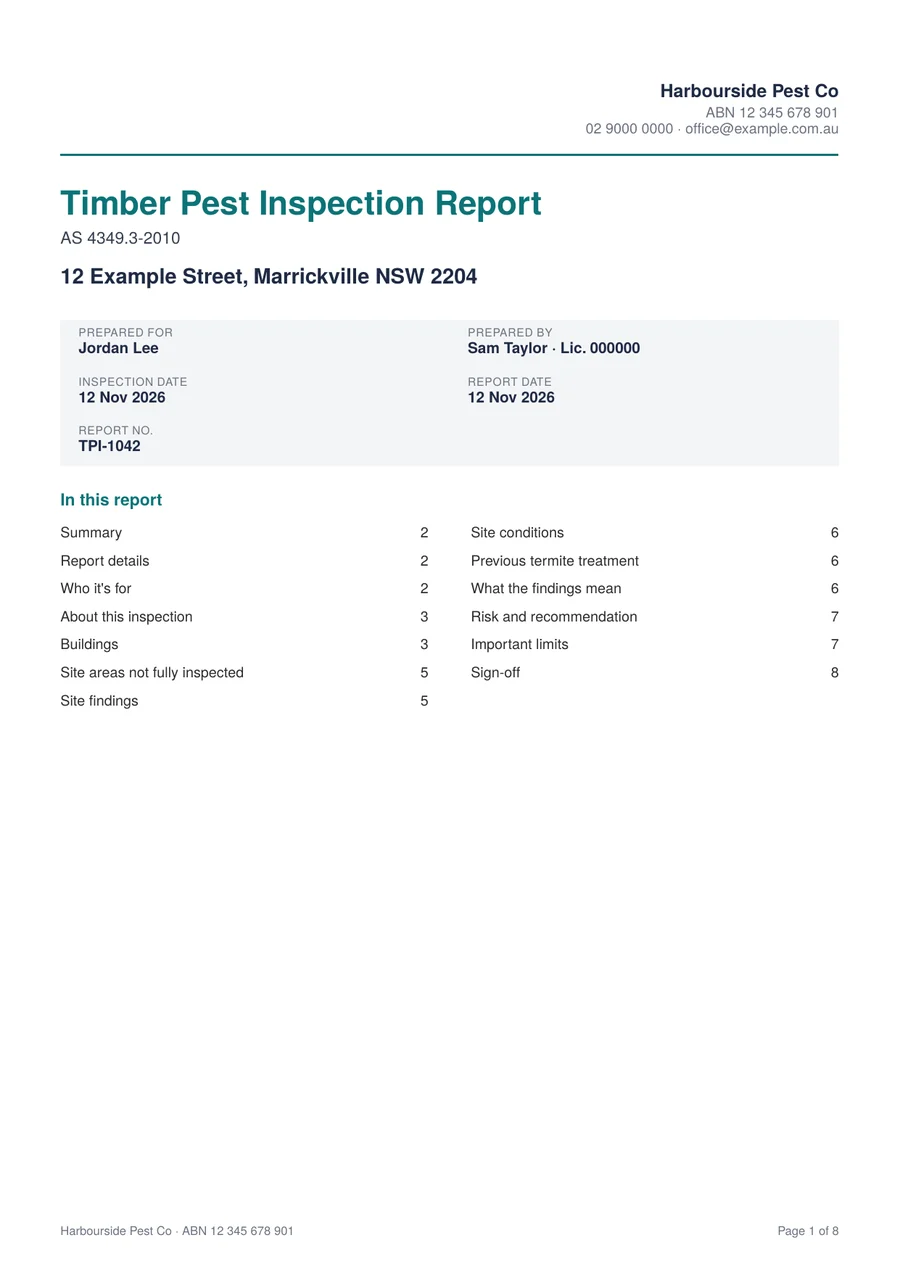
Here's the cover of a sample timber pest report made in Avro, with made-up details:
A checklist you can use
Before a report goes out, check it has:
- Report number, report date and inspection date
- Client, and who booked it
- Property address
- Inspector name, business and licence number
- Reference to the pre-inspection agreement
- The Standard and edition the inspection was done to
- A summary that matches the body
- Description of each building: construction, floor type, roof
- Areas inspected, including the site distance
- Every area not inspected, with the reason
- Live termites: yes or no, and where
- Termite workings and damage
- Borers and wood decay fungi
- Evidence of previous treatment and the durable notice
- Conducive conditions, each with an action and a trade
- Moisture readings and the meter used
- Risk of undetected activity, explained
- Recommendations, including a termite management plan where termites were found
- Next inspection interval
- Sketch of findings and high-risk areas
- Photos, referred to in the comments
- Scope limits and disclaimers
- Signature and date
For the longer on-site version, see what goes in a termite inspection report. For how AS 4349.3 and AS 3660 fit together, see the termite standards in plain English.
Writing it on site
Avro AI is built by a pest tech. It has a timber pest inspection report set out for AS 4349.3-2010, with the summary first, a section for areas not fully inspected and why, conducive conditions by area, the durable notice with a photo, the risk and next inspection, a sketch, and photos next to each finding. It works offline in the phone's browser for subfloors with no signal. The pre-inspection agreement can go to the client on a sign-and-return link. The finished report goes as a PDF, attached to the invoice from the same job.
Start free, no card needed.
This page is general information, not legal or technical advice. It summarises AS 4349.3 in our own words and doesn't reproduce the Standard. Check the current Standard, your licence conditions and your insurer's requirements.
FAQ
Is AS 4349.3 a legal requirement?
The Standard itself is a voluntary document, but government guidance points timber pest inspectors to it, and some state laws and many insurers and contracts expect inspections to follow it. Check what applies in your state and under your insurance.
Does an AS 4349.3 inspection include drywood termites or mould?
Public summaries of the Standard say no. A standard inspection covers subterranean and dampwood termites, borers of seasoned timber and wood decay fungi. Anything else needs a special-purpose inspection agreed in writing.
Can a timber pest report include a quote for treatment?
Keep them separate. The report records what was found and recommends a termite management plan where termites were found. The plan and the price go in their own documents.
What's the difference between AS 4349.3 and AS 3660.2?
AS 4349.3 covers inspecting and reporting on timber pests. AS 3660.2 covers managing termites in and around existing buildings, including the management plan and treatment. One job often uses both, as separate documents.
Does using report software make my report compliant?
No. Software gives you a structure. Whether the report meets the Standard depends on the inspection and what you write. Ask any software maker for a sample report and check it against the list above.
Sources
- https://ablis.business.gov.au/ACT/pages/7b1dcdde-af2e-49a6-9286-a8575b13df05.aspx (Australian Government ABLIS listing for AS 4349.3-2010: purpose as the minimum for visual inspection and reporting, all building classes, intended users). Checked 15 Nov 2026.
- https://descomconsultant.squarespace.com/as-4349-3-timber-pest-inspection-standards (consultant's summary: pests in scope, drywood termites and mould excluded, scope agreed in writing, visual and non-invasive, report contents). Checked 15 Nov 2026.
- https://professionalpestmanager.com/termites/buying-a-home/ (trade magazine: pre-purchase inspections are visual; report covers activity and damage, conducive conditions, limitations, recommendations; invasive inspection needs the seller's approval). Checked 15 Nov 2026.
- https://www.consumerprotection.wa.gov.au/consumer-protection/property-inspections (WA Consumer Protection: timber pest inspections should be done to AS 4349.3; report covers current activity, past damage, risk areas, recommendations). Checked 15 Nov 2026.
- https://store.standards.org.au/product/as-4349-3-2010 (Standards Australia listing; title and edition. Page didn't render from here, so currency not confirmed). Checked 15 Nov 2026.
- Avro's own sample image: public/marketing/product/report-page.webp (made-up details). Checked 15 Nov 2026.
- Avro's own template: lib/reports/templates.ts, timber-pest-inspection-v2 (section names used in "Writing it on site"). Checked 15 Nov 2026.